Goals that make it past March.
SHEPHERD reads every goal, catches two teams doing the same work, runs the check-in, and hands each person the next step that moves their goal, for everyone, on your cadence. You still make every call.
Works with the tools your team already uses
Sales, marketing, people, operations and every other function set goals in their own words. SHEPHERD ties them to the same company priorities and shows each leader where teams depend on, or duplicate, each other. Skill packs for sales, marketing, people, and legal make Shepherd think like that function's leader, with more to come.
Select a function to see how SHEPHERD runs it. Example objectives for illustration.


Two teams have goals to rebuild customer onboarding this quarter. Marketing owns one, Product owns the other, and neither links to the other.
The navigator reads every goal in the company and flags duplicated work, hidden dependencies and escalations. A named person decides each one.

Good morning. Two things need you this week and nothing else does.
Decide: the onboarding goals in Marketing and Product overlap. One owner, one goal.
Your committed goal on decision latency is at 19 days against 12, with six weeks left. Elena flagged a blocker on intake in Thursday's check-in.
No time on what is going well. Line of sight is ahead of pace.
Each person gets a short note on what needs them this week, in the app or posted to Teams or Slack.

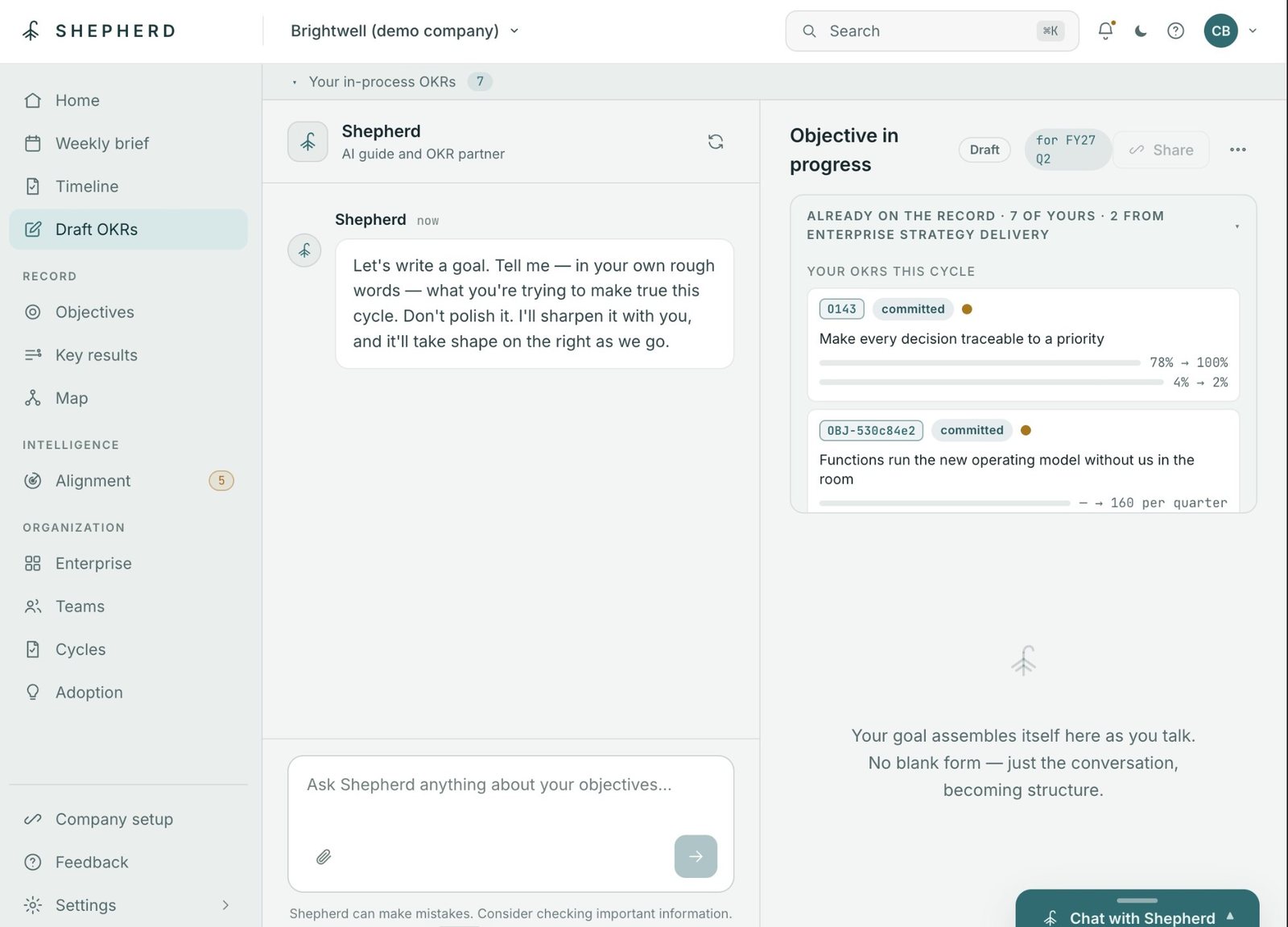
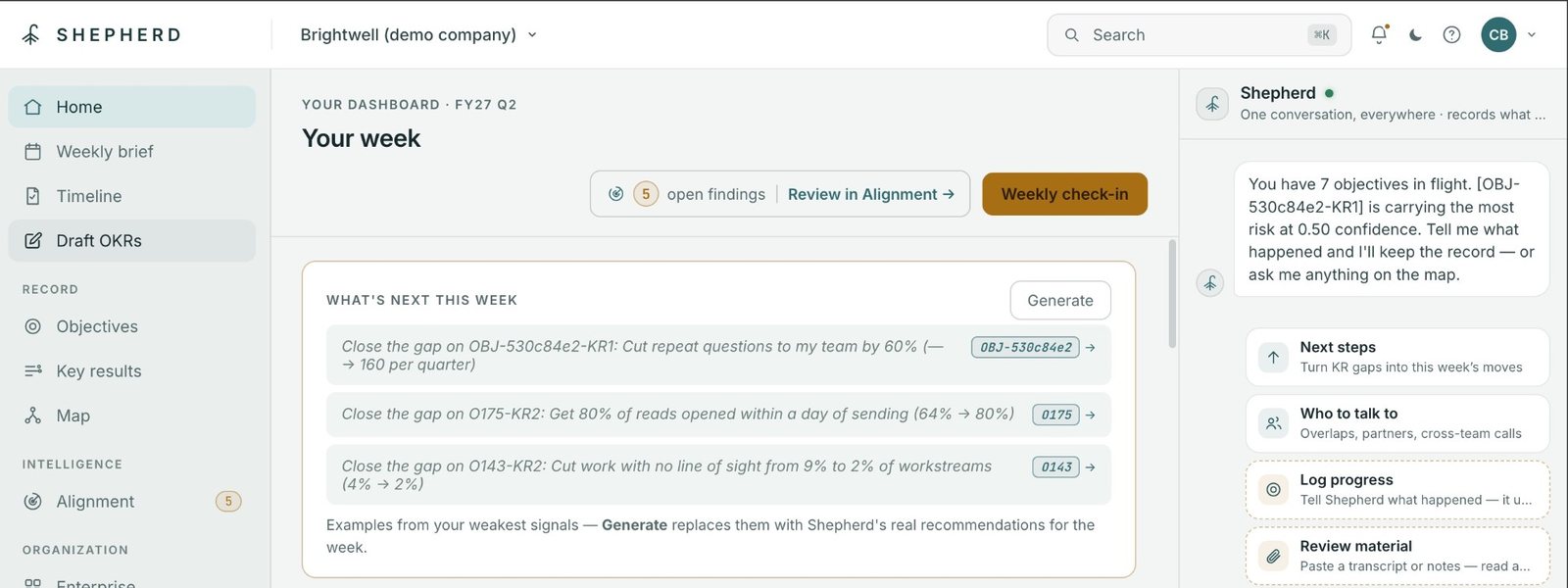
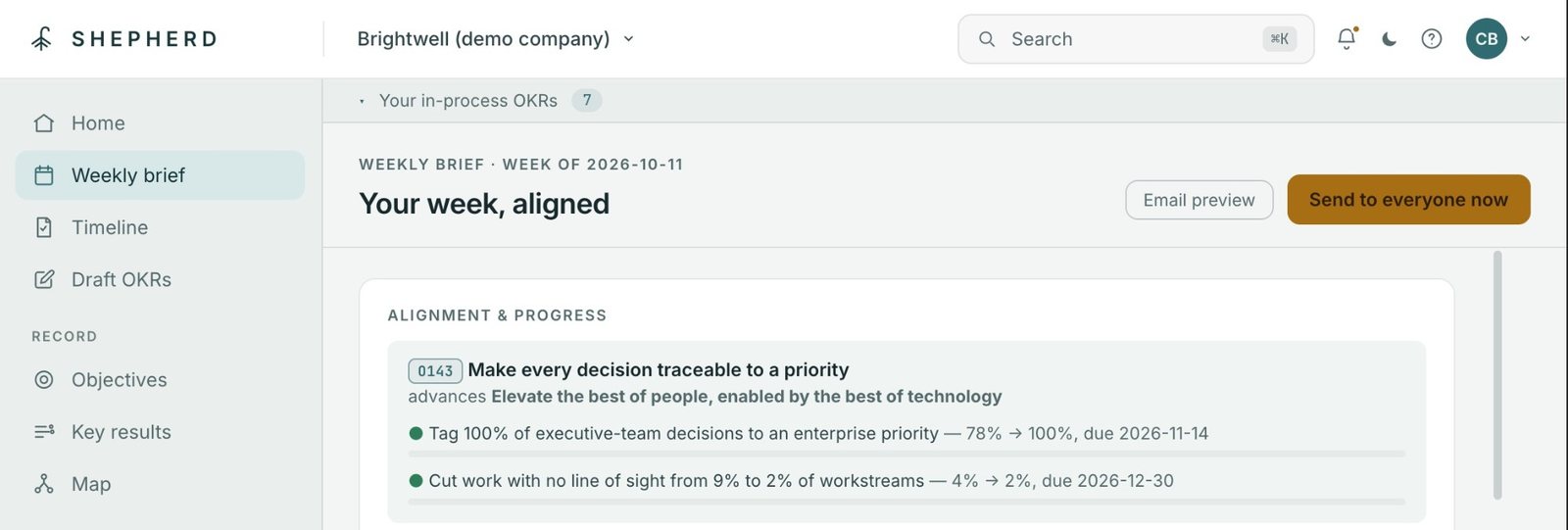
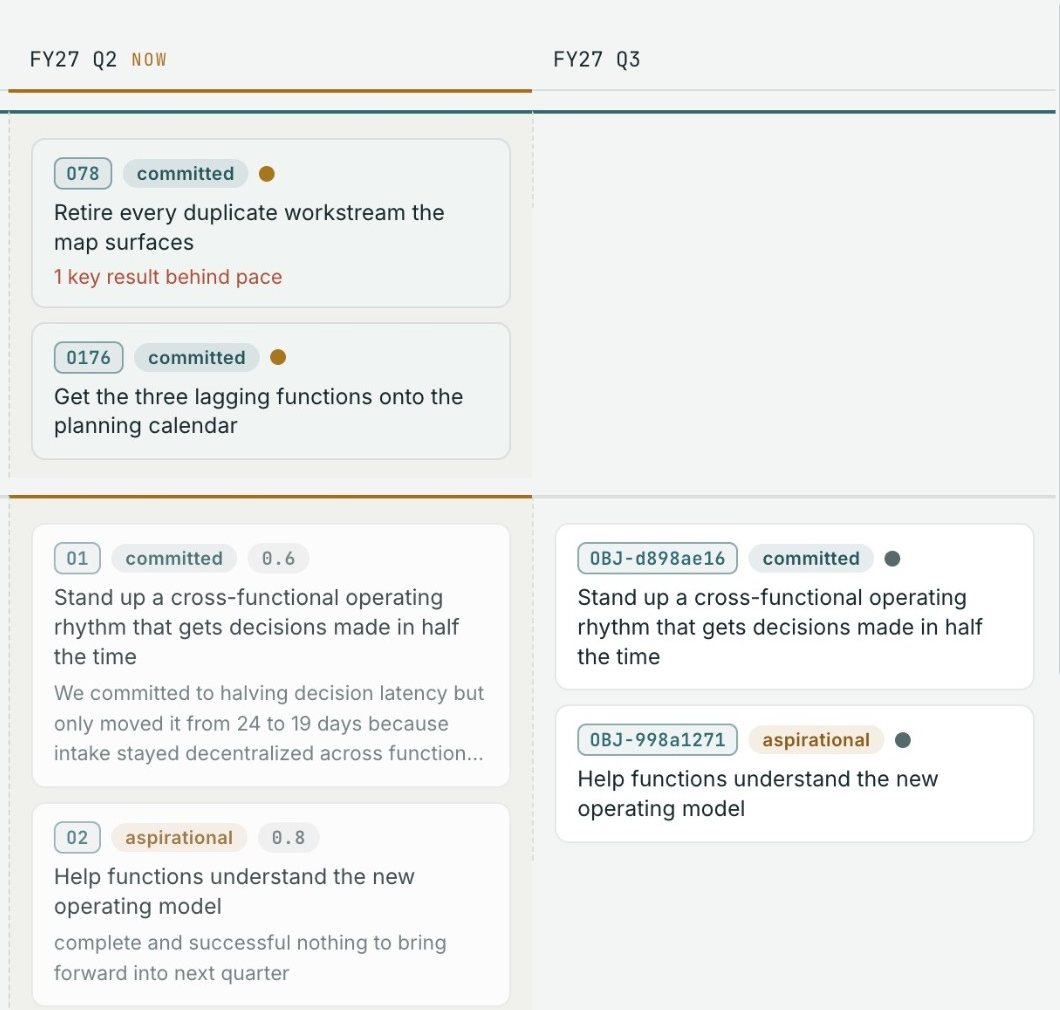
Screens from the current build, shown with Brightwell, the fictional 200-person demo company SHEPHERD ships with.
Pick one. Watch Shepherd push back the way it does in the product, then turn it into an objective someone can score.
Your goal assembles here as you talk. No blank form, just the conversation becoming structure.
A scripted example with made-up numbers. The real coach works on your own words and your company's goals.
SHEPHERD keeps every goal on one live map connected to the priority it serves, then does the follow-through that usually falls to one overworked person.
Each person opens to what moved, the findings waiting for them, and the weekly check-in. Shepherd is one message away, holding the whole company's goals. Ask what to do next and it answers from your own key results: the gap, the blocker, the person to talk to, in the order to do them. It logs progress when you report it. The thinking that used to take a week of status meetings takes a message, and you decide.

Leaders see each objective with the priority it advances and its key results moving toward target. A goal that ladders to nothing stands out, so it can be fixed or dropped.

The timeline shows your goals and your team's next to each other, quarter over quarter. Every close-out keeps its score and its lesson, so a missed commitment shapes the next cycle instead of disappearing.

A conversation turns a rough goal into an objective with key results, and pushes back when a goal is vague, duplicated, or just a list of activities.
Every goal on one map, laddered to the priority, initiative, and workstream it serves. Line of sight from any goal to the strategy.
Duplicated work, hidden dependencies, and escalations, found by the navigator and decided by a person.
Each week owners report progress, confidence, and blockers. A committed goal that slips escalates on its own.
Each person gets a short note on what needs them this week, with the recommended next steps for their goals, in the app or posted to Teams or Slack.
Scoring, reflection, and a written lesson for every missed commitment before the cycle can close. What carries forward is decided, not forgotten.
For every goal, Shepherd works out the next move from the key result's gap to target, its confidence, its blockers, and the work connected to it, and names the person to involve. Steps come sequenced and sized to days, not quarters. That is how SHEPHERD speeds a person to a decision or an action: the analysis is already done when they sit down, and they make the call.

In a spreadsheet, two teams can own the same work for a whole quarter and nobody notices. On the map, every goal connects to the priority it serves, and Shepherd flags the overlap the week it appears.

No consultants and no blank screens. Load five things in order; each import is checked first and writes nothing if a row is wrong. By Monday, every goal owner opens to what needs them.

We are working with a small number of companies of 100 to 500 people that already try to run on goals. You get the full product and a direct line to the team that builds it. We learn what to build next from you.

Viva Goals closed at the end of 2025 and Quantive is now part of WorkBoard. If you want something between a spreadsheet and an enterprise suite, SHEPHERD loads your existing goals from spreadsheets and posts check-ins and Monday notes to Teams.
Goals carry strategy. SHEPHERD is built so each company's data is separate, visible only to the right people, and never used to train a model.
The best-run companies have someone who reads every goal and keeps the weekly rhythm going. SHEPHERD turns that follow-through into software, so the goals you set in January still matter in December.
Thirty minutes, on the demo company or a sample of your own goals. Write to us with your name, company, and how many people set goals.